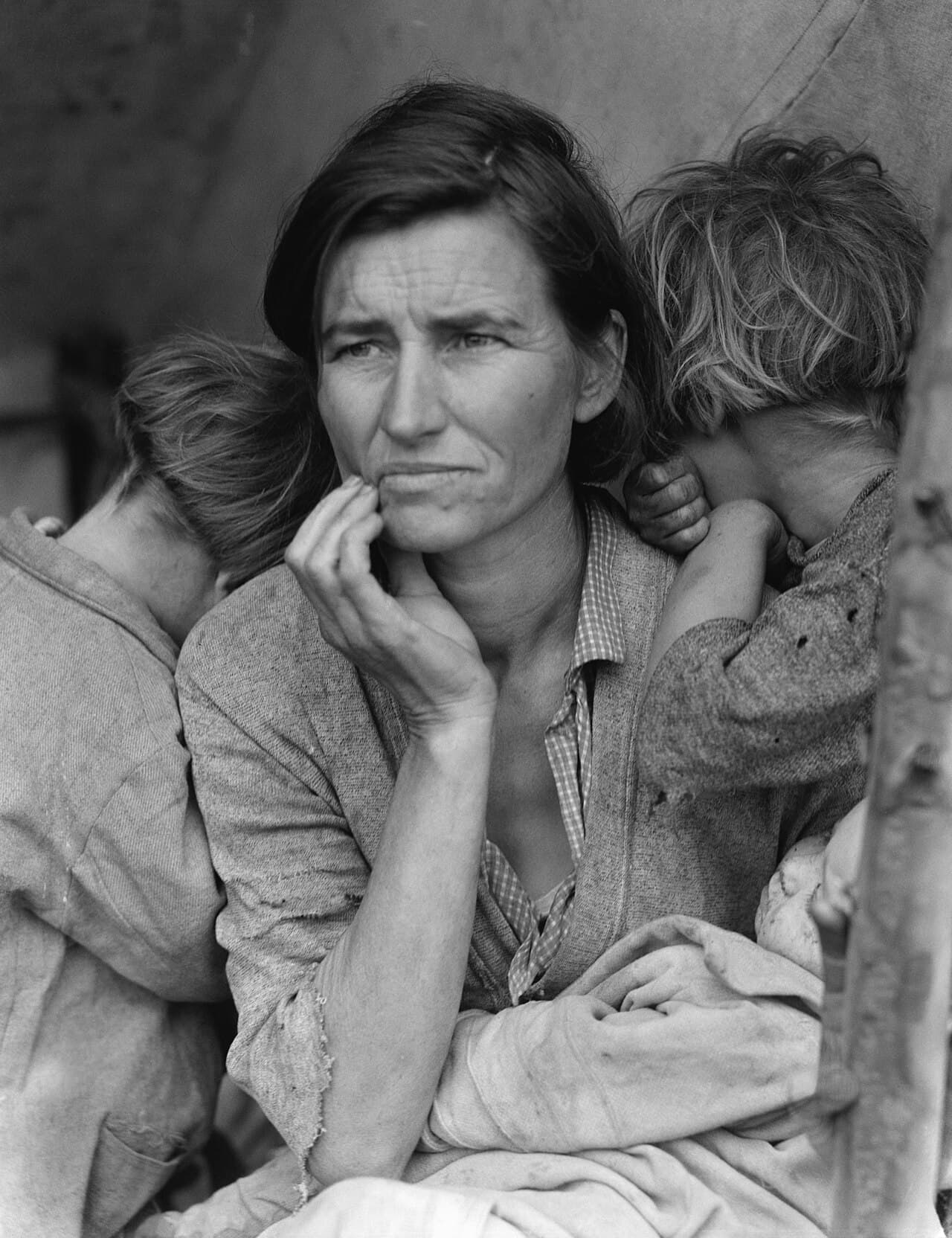
A mother looks past the camera, hand at her chin, two children turning their faces away into her shoulders, a baby asleep in her lap. Her face is 32 years old and looks fifty. Once you have seen it, every documentary photograph of hardship is measured against it, usually without anyone saying so.
In March 1936, Dorothea Lange was driving home after a month of photographing farm workers for a US government agency documenting the Depression. She passed a hand-painted sign: PEA PICKERS CAMP. She drove on for twenty miles, arguing with herself, then turned around.
What you're looking at
Nipomo, California. A freeze had destroyed the pea crop, and about 2,500 stranded pickers were starving in a roadside camp. Lange spent perhaps ten minutes with one family under a lean-to tent, making six exposures, moving closer with each one. This is the sixth. The woman was Florence Owens Thompson, though the world would not learn her name for another forty years.
What makes it special
It is composed like a Renaissance painting. A triangle of figures, the mother's face at the apex, the children's turned heads framing her like mourning angels: the geometry of a Madonna, transplanted into a canvas tent. Lange did not invent this resemblance, but she recognized it in seconds and moved her camera until it locked into place. That is why the image feels timeless instead of merely sad.
It worked immediately. Within days, the photograph ran in San Francisco newspapers. The federal government rushed twenty thousand pounds of food to the Nipomo camp. Very few images in history have a direct, documented, humanitarian result measured in freight. This one does, though the Thompson family had already moved on and never received any of it.
The turned-away children are the masterstroke. Faces would have made it a picture of specific unfortunate people. Turned away, the children become every child, and the mother's worry becomes structural, not personal. The photograph stops being about one family and becomes about a country.
The story behind it
Thompson herself had a complicated relationship with her fame. She was a full-blooded Cherokee woman raising seven children, fiercely competent, and for decades anonymous while her face appeared in textbooks. When journalists found her in the 1970s, she said the photograph had never done anything for her. Late in her life, when she fell ill, strangers who knew her face raised tens of thousands of dollars for her care. Her gravestone reads: Migrant Mother, a legend of the strength of American motherhood.
One detail most people miss
In the bottom right corner of early prints, a thumb hovers at the tent pole, Thompson's grip on the flap. Lange had it retouched out of the negative, judging it a distraction. That tiny erasure is now taught in journalism schools: the most trusted photograph of its century contains one small, deliberate edit, and the debate about where documentation ends has never closed since.
Where to see it
The negative belongs to the American people: it sits in the Library of Congress, free for anyone to reproduce, which is partly why it is everywhere. Prints hang in MoMA and the Getty. Lange later said of the encounter that Thompson seemed to know the pictures might help others, "and so she helped me." Both women were right.