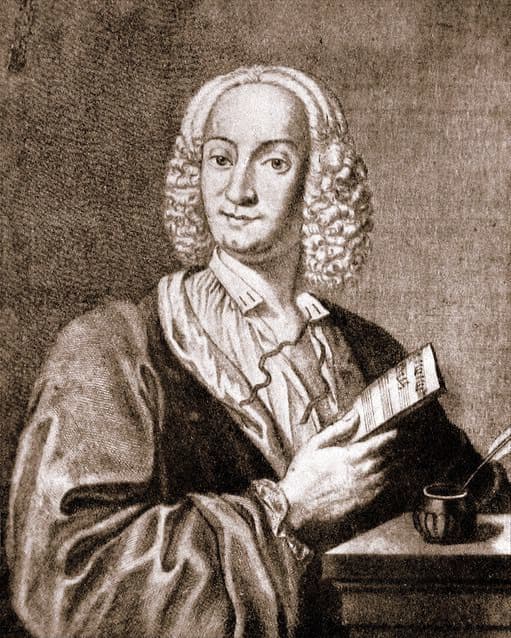
Before films had soundtracks, before anyone spoke of sound design, a red-haired Venetian priest wrote music in which you can hear teeth chattering. Not metaphorically: the violins tremble in tight, shivering repetitions, and the score itself is labeled, in Italian, frozen and shivering in the icy snow. Vivaldi was not painting a mood. He was painting weather, and he left captions.
The Four Seasons, published in 1725, is a set of four violin concertos, one per season, and each comes with a sonnet, probably written by Vivaldi himself. Winter is the last and the most cinematic of the four.
What you're listening to
A concerto: one solo violin against a small string orchestra, three movements, fast then slow then fast. In the first movement, the orchestra builds a wall of icy tremolo while the soloist gusts across it like wind; listen for the moment the whole ensemble starts stamping its feet to stay warm. The second movement moves indoors: plucked strings imitate rain dripping on the roof while the solo violin, warm and unhurried, is you beside the fire. The finale goes back outside, onto the ice: careful sliding steps, then running, then the crack, the fall, and a final storm.
What makes it special
It is a soundtrack without a film. Every image above is not interpretation but instruction: the sonnets' lines are printed in the score at the exact bars where they happen. Vivaldi invented, in 1725, the grammar every film composer still uses: tremolo for tension, pizzicato for raindrops, a solo voice for the individual against the elements.
The slow movement is the most comfortable music ever written. The Largo of Winter, two minutes of melody over gentle plucking, is contentment itself: the whole point is that the storm is outside and you are not. It has been borrowed by films and advertisements for decades, usually to signal exactly that feeling.
It survived total oblivion. After Vivaldi died poor in Vienna in 1741, his music vanished for nearly two hundred years. The revival came only in the twentieth century, when scholars unearthed his manuscripts. Within decades, The Four Seasons went from unknown to the most recorded classical work on the planet. Immortality skipped eight generations, then arrived all at once.
The story behind it
Vivaldi taught at the Ospedale della Pietà, a Venetian orphanage for girls, for most of his career. Its all-female orchestra, performing behind grilles, became one of the wonders of Europe, and much of his fiercest violin writing was composed for those teenagers. The red-haired priest who rarely said Mass, citing his asthma, wrote around five hundred concertos for them and for a continent that could not get enough, until fashion moved on and he died with almost nothing.
One detail most people miss
The sonnet for Winter ends not with a complaint but with a shrug of joy: this is winter, but even so, what delight it brings. Listen to the final bars with that line in mind. The storm music is grinning. Vivaldi's weather report was never about suffering the cold; it was about being gloriously alive in it.
How to listen
The performance above, by Voices of Music on instruments of Vivaldi's own era, plays it at the bite and speed he intended. Listen once while you read the images, once without. If you can, save the Largo for tonight, indoors, lights low, weather optional.