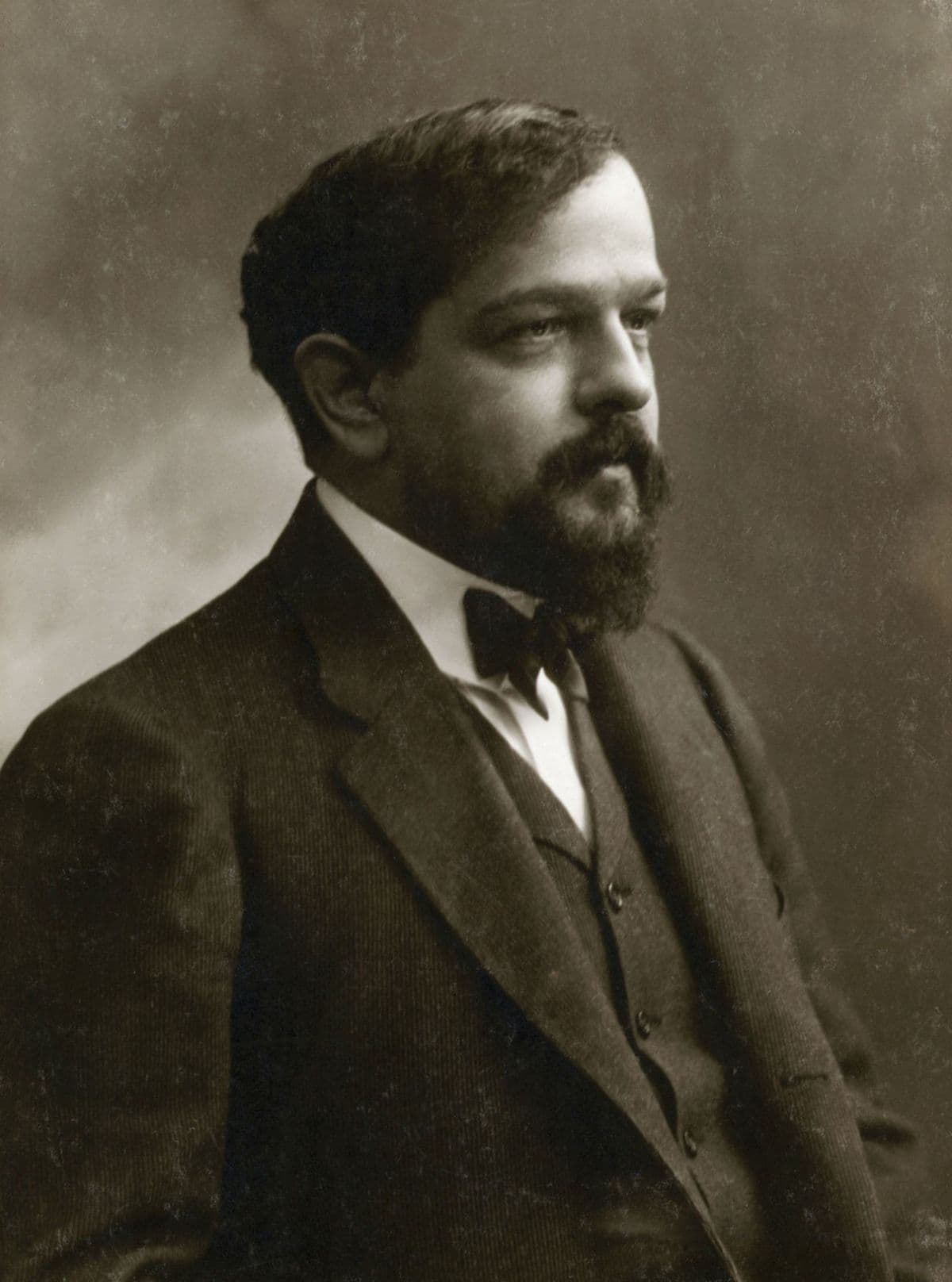
Some music asks for your attention. This piece does the opposite: it lowers its voice until the whole room leans in. Five minutes long, almost never louder than a murmur, and somehow the most famous thing ever written for the piano. You have heard it in films, in commercials, at weddings, possibly without ever learning its name.
Claude Debussy wrote it young, around 1890, and kept it in a drawer for fifteen years, unsure it was good enough. It was published in 1905 as the third movement of his Suite bergamasque. The title comes from a poem by Paul Verlaine: moonlight, masks, a garden where even the fountains seem to be dreaming.
What you're listening to
It opens with two hands moving together, soft as breath, in a key with five flats that pianists describe as velvet under the fingers. The left hand soon begins to ripple, slow arpeggios like light moving on water, while the right hand carries a melody that never insists, never repeats itself exactly. There is a swell in the middle, the closest the piece comes to passion, and then the moonlight settles back down and dissolves.
What makes it special
It almost never rises above a whisper. Look at the score and you find pianissimo everywhere and hardly a single true forte. Debussy builds intensity not by getting louder but by getting warmer, adding notes the way a sunset adds color. The most famous piano piece in the world is, technically, five minutes of quiet.
The harmonies float instead of marching. Classical music before Debussy worked like grammar: tension, then resolution, question, then answer. Debussy lets chords drift into each other without resolving, which is why the piece feels suspended, out of time. He was doing with sound what Monet was doing with light.
It changed what a piano is for. Before this, the piano mostly told stories or displayed brilliance. Clair de lune made the piano an instrument of atmosphere. Every film score that sets a mood with a few quiet piano notes descends from these five minutes.
The story behind it
Debussy hated labels, especially "impressionist," which critics borrowed from painting to describe him. At the Paris Conservatoire he maddened his teachers by breaking harmonic rules; asked what rules he did follow, he answered: my own pleasure. He nearly did not publish this piece at all, embarrassed by its early style. It became the one thing everybody knows him by, and paid his bills for the rest of his life.
One detail most people miss
The piece ends with the same rippling figure it used in the middle, but slower, thinner, as if the light itself is going out. There is no final flourish, no bow to the audience. It does not end so much as stop being audible, the musical equivalent of a moon slipping behind a cloud.
How to listen
Once while you read, once in the dark. In the recording above, Pascal Rogé plays it with the patience it deserves. One instruction only: notice that you cannot tell where the melody ends and the accompaniment begins. That blur is the whole point.