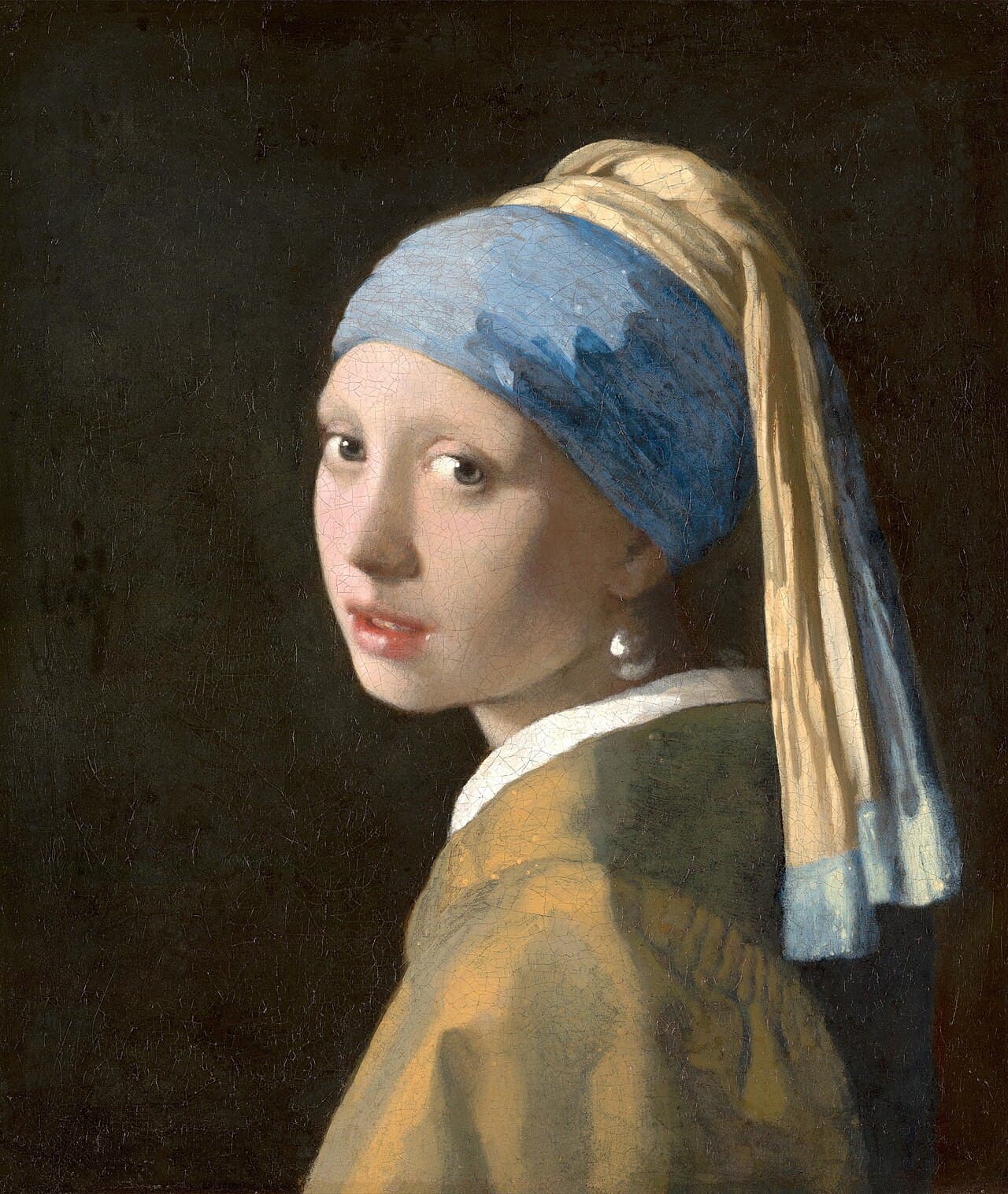
She turns toward you as if you have just said her name. Lips slightly parted, eyes catching the light, a question forming. In a museum in The Hague, people stand in front of this small painting and wait, almost politely, for her to answer. She has been about to speak for three and a half centuries.
Johannes Vermeer painted her around 1665 in Delft, a quiet Dutch town where he lived his whole life, painted slowly, and died in debt at 43. We do not know who she is. A daughter? A maid? Nobody at all? The Dutch had a word for this kind of picture, and that word unlocks the whole painting.
What you're looking at
A girl against a dark background, wearing a blue and yellow turban and one enormous pearl. That is the entire inventory. No room, no window, no table, no story. Vermeer removed everything a painting of his time was supposed to have, and kept only what a human face needs to feel alive: light, and someone to turn toward.
What makes it special
There is almost no drawing in it. Come close and the magic gets stranger: her nose has no outline, the line between nose and cheek simply is not there. The famous pearl is two brushstrokes, one soft glow and one bright dot. The wet corner of her mouth is a single pink touch. Vermeer discovered how little information an eye needs, and gave exactly that much, nothing more.
The background was not black. It was originally a deep, glossy green, painted as a curtain. The glazes have darkened over the centuries, and the accident improved the picture: she now floats in a darkness that belongs to no room and no century.
The turban is the boldest choice. No Dutch girl dressed like this. The exotic costume signals that this is fiction, a character study, which freed Vermeer from every rule of portraiture. He did not have to flatter anyone. He only had to make her alive.
The story behind it
Vermeer left about 36 paintings, one of the smallest bodies of work of any great painter, and then the world simply forgot him for two hundred years. He was rediscovered in the 1860s by a French critic, Théophile Thoré-Bürger, who hunted his scattered canvases across Europe like a detective. The Girl was bought at auction in 1881 for about two guilders, roughly the price of a decent dinner. Tracy Chevalier's 1999 novel and the film with Scarlett Johansson invented a story for her, precisely because the painting refuses to tell one.
One detail most people miss
Look at the pearl. It has no hook, no chain, no visible way of hanging from her ear. It simply floats in the shadow of her jaw. Some scholars think it is not a pearl at all but polished glass, or an invention. It does not matter. Vermeer knew you would believe it, because everything around it feels true.
Where to see it
The Mauritshuis in The Hague, a jewel-box museum fifteen minutes from the Amsterdam train line. She hangs at eye level. Stand slightly to her left, and the turn of her head is aimed exactly at you.