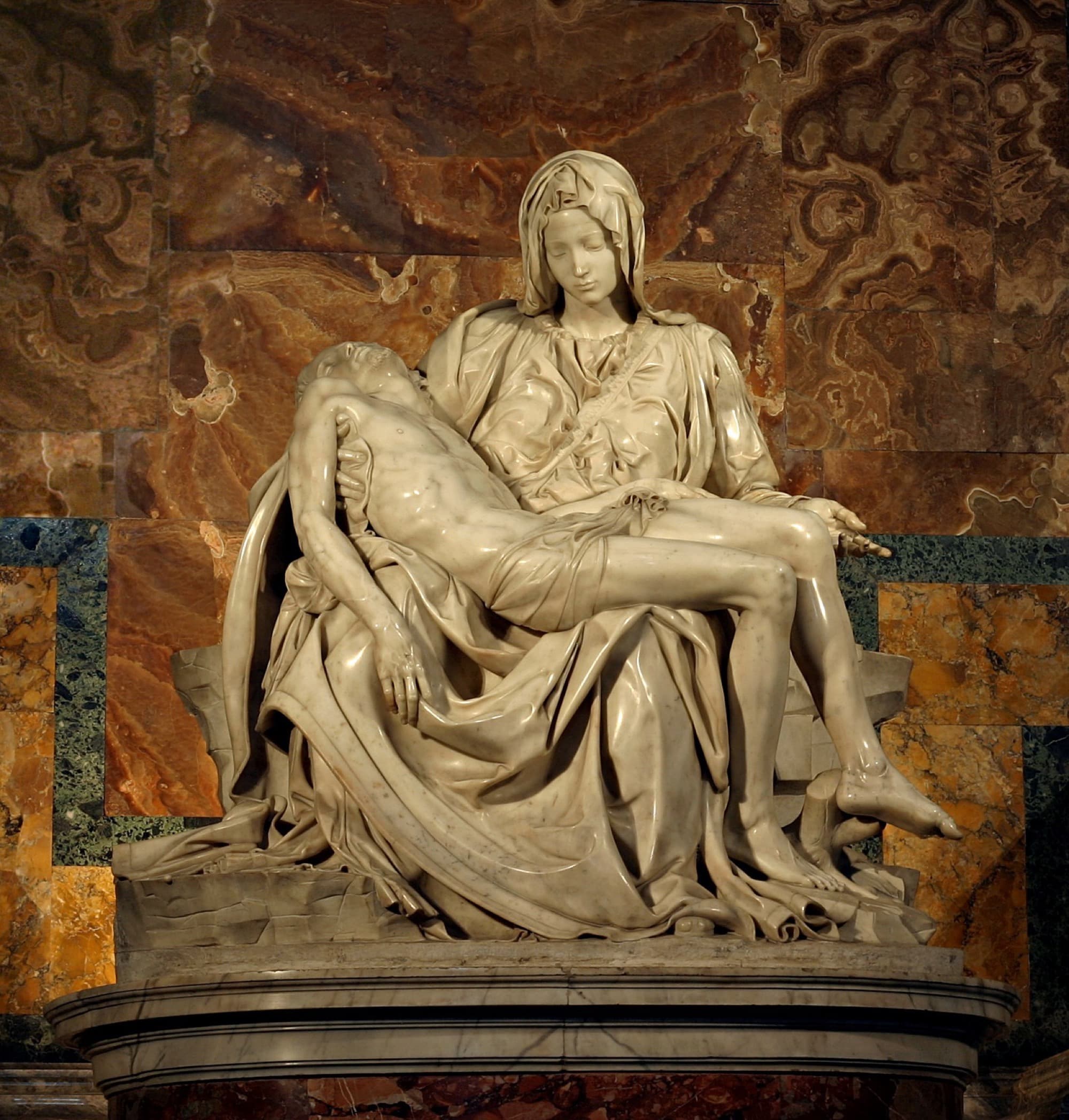
Across the band of cloth on the Virgin Mary's chest, there is a name: Michelangelo's. It is the only work he ever signed. The story goes that soon after he finished the Pietà, the young sculptor overheard a group of visitors admiring it and crediting it to a better-known rival. That night he let himself back in and carved his signature into the marble, so no one could ever mistake who had made it. He is said to have been so ashamed of this flash of vanity that he never signed another sculpture again.
He was about twenty-three years old. It is one of the most accomplished objects any human has ever carved, and he made it before he was twenty-five.
What you're looking at
The subject is a Pietà, a word meaning pity or compassion: the Virgin Mary holding the body of her son Jesus after he has been taken down from the cross. Mary sits, draped in vast folds of marble robe, and across her lap lies the dead Christ, his body limp, his head fallen back, one arm hanging. It stands in St. Peter's Basilica in the Vatican, carved from a single block of white Carrara marble, and it is polished so smoothly that the cold stone seems to turn into soft skin and heavy cloth.
What makes it special
The Virgin looks younger than her dead son. Mary's face is that of a calm young woman, seemingly no older than the grown man across her knees. This is not an error. When questioned about it, Michelangelo argued that her purity kept her eternally young. He was sculpting an idea, not a literal mother, and chose serene, timeless beauty over biological fact.
Grief without gore. There is almost no violence on display. Christ's wounds are barely there; his body is beautiful, not broken. Mary does not wail. She looks down with a quiet, accepting sorrow, one hand turned gently outward, as if presenting her son to us. The restraint makes the sadness heavier, not lighter.
It turns stone into flesh and cloth. Look at the veins on Christ's arm, the slack weight of his hand, the deep rivers of drapery in Mary's robe. Michelangelo makes marble do things it should not be able to do: look warm, look soft, look dead. One hard material, worked into skin, bone, and fabric at once.
The story behind it
A French cardinal living in Rome commissioned the sculpture for his own tomb, asking for a Virgin and dead Christ. Michelangelo, already fiercely ambitious, treated it as his calling card, the work that would prove he was the finest sculptor alive. It did exactly that. The Pietà made his reputation almost overnight and set him on the path to the Sistine ceiling and the statue of David. For the rest of his long life he returned to the Pietà subject again and again, including a rough, unfinished version he was still carving as an old man, days before he died.
One detail most people miss
The Pietà now sits behind bulletproof glass, and there is a dark reason why. In 1972 a man climbed over the railing and attacked it with a hammer, striking more than a dozen blows, shouting that he was Jesus Christ. He smashed part of Mary's arm, her nose, and an eyelid before he was pulled away. Restorers rebuilt the damage using marble dust from the statue itself and surviving fragments, and the repairs are nearly invisible. But that is why you now view one of the world's most tender images from a careful distance, through a sheet of protective glass.
Where to see it
The Pietà is in St. Peter's Basilica in Vatican City, just inside the entrance, on the right. Entry to the basilica is free, though the security line can be long. Because of the glass and the crowds, you cannot get very close, so look for the things that survive the distance: the impossible youth of Mary's face, the dead weight of Christ's hand, and, if the light is right, the single proud signature a twenty-three-year-old cut across his masterpiece.