For centuries, paintings of war were advertisements. They showed brave heroes, noble deaths, and victorious generals on rearing horses, all arranged to make slaughter look like glory. Then Goya painted this, and the tradition broke.
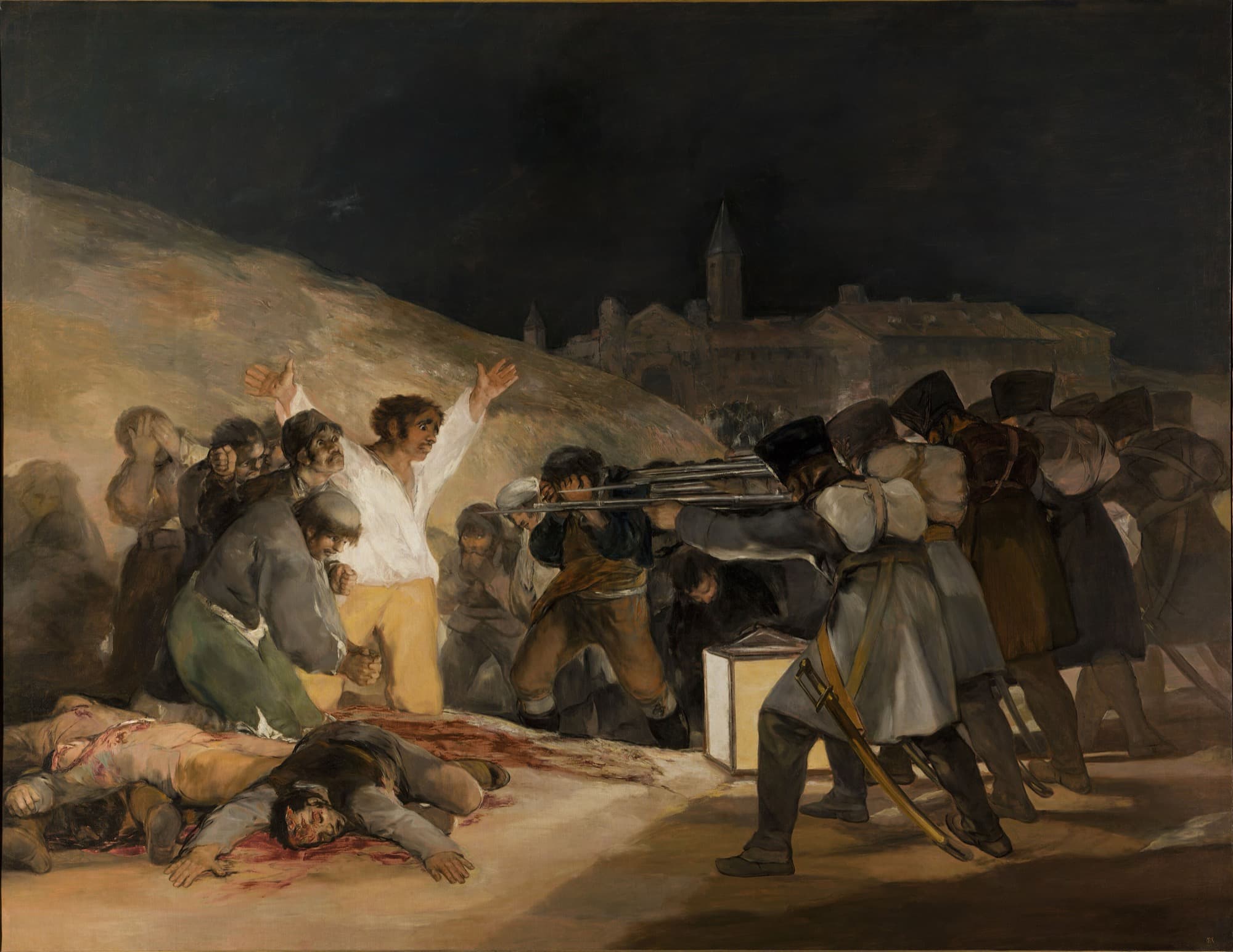
There is no hero here, not really. At the center, lit by a single lantern on the ground, a man in a white shirt throws his arms up and screams, a heartbeat before a firing squad kills him. He has no name. Around him lie the bodies of those already shot, face down in their own blood, and behind him a line of terrified men wait their turn. It is often called the first truly modern painting, because it may be the first that simply tells the truth about being killed.
What you're looking at
The scene shows a real event. On the second of May, 1808, the people of Madrid rose up against the French army that had occupied Spain under Napoleon. That night and into the next day, the French rounded up Spaniards and executed them in reprisal. Goya painted this in 1814, after the French were finally driven out, to commemorate his countrymen's resistance. On the right, a squad of soldiers stands in a rigid, faceless row, rifles raised. On the left, the condemned civilians recoil in the lantern light, and the glowing white-shirted man stares his killers down.
What makes it special
The victim is a nobody, and that is the point. He is not a general or a saint. He is an anonymous working man, and Goya gives him the painting's only real light, its emotional center, and a pose with arms flung wide, echoing the crucifixion. Look closely at his right hand and you can see a dark mark, like the wound of Christ. An ordinary man dies like a martyr, and Goya insists we feel it.
The killers are a machine. We never see the soldiers' faces. They are a wall of backs, hats, and identical rifles, anonymous and mechanical, more a device than a group of men. By erasing their humanity, Goya shows how organized killing works: it turns people into a procedure.
The light does the accusing. This is tenebrism at full force. The big lantern on the ground floods the victims while the executioners stay dim. The brightest thing in the picture is a man about to be shot, so your eye cannot escape him, which is exactly what Goya wants.
The story behind it
Goya was Spain's leading painter, a court portraitist who had served the very monarchy the French overthrew. He lived through the occupation and its horrors, and he was going deaf and growing darker in spirit. The Third of May belongs to that turn. In the years around it he also made a savage series of prints called The Disasters of War, filled with torture, famine, and atrocity, too bleak to publish in his lifetime. This painting carried that same refusal to look away, but at the scale and ambition of a grand public masterpiece. Its influence runs straight through later art, into Manet's execution scenes and Picasso's Guernica.
One detail most people miss
Look past the central man into the dark hillside behind the firing squad. On it sits a shadowy building, often read as a church, its tower a blunt silhouette against the night sky. Faith is present in the scene, in the man's pose, in that distant church, and it offers no rescue. The soldiers keep firing in its shadow. Goya sets the oldest promise of mercy right behind the guns, and lets you notice that it changes nothing at all.
Where to see it
The Third of May 1808 hangs in the Museo del Prado in Madrid, usually near its companion, The Second of May, which shows the uprising itself. Stand close enough to see the lantern light and the mark on the white-shirted man's hand, then step back and feel how the whole dark canvas pushes your eye toward the one bright, doomed figure. It is not a comfortable painting. It was never meant to be.